
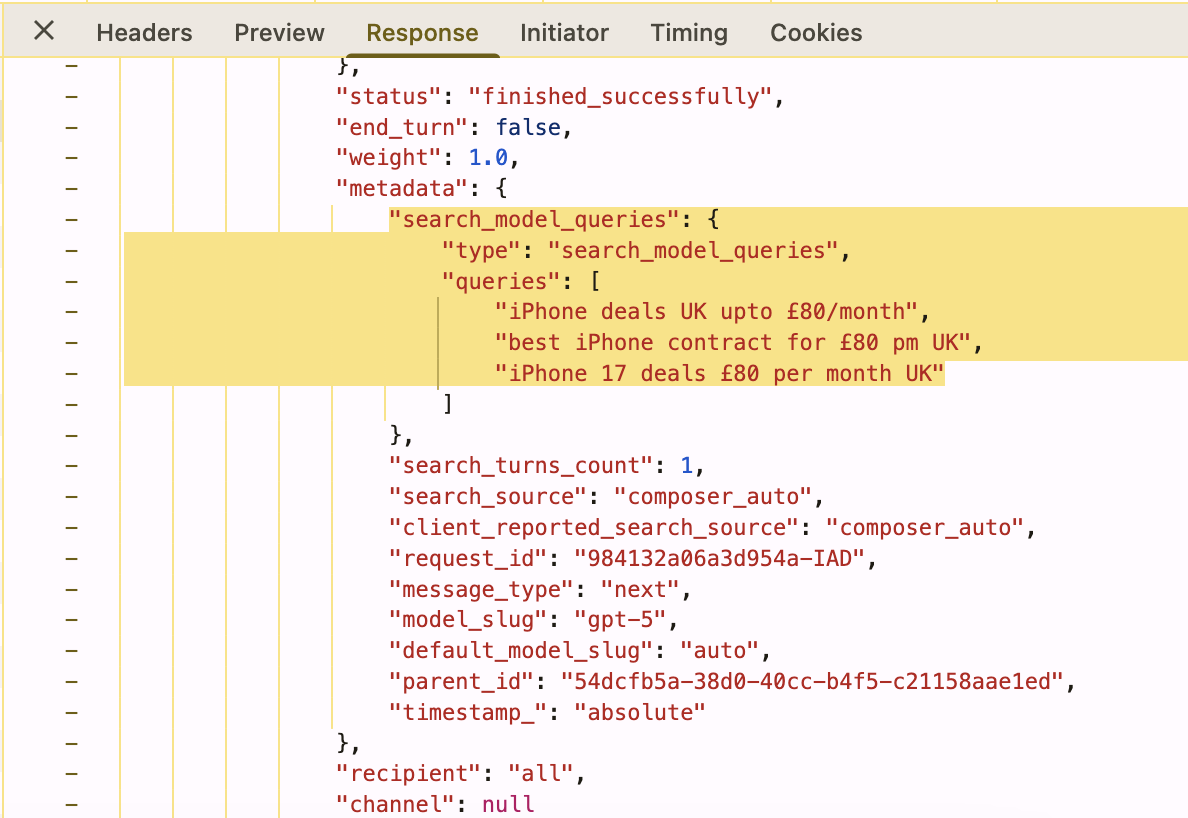
Lately, there’s been curiosity among marketers about ChatGPT’s ‘search_model_queries’ and its ability to reveal how the AI transforms a user prompt into something closer to familiar search phrases.
I have to admit, it got me excited too. Having endured the traumatising shift from rich keyword data to ‘not provided’ in organic search reports, any hint of a secret door to unlock search terms is enough to get any seasoned SEO hyped.
There have been suggestions that ChatGPT’s ‘search_model_queries’ script gives us a peek into how the AI “searches” for content. While these queries offer interesting insights, they’re not a shortcut to AI visibility – and that’s actually a good thing, it means quality content still wins.
How ChatGPT searches for information
I’ve seen people wonder whether ChatGPT is just using those fan-out queries to search Google’s SERPs, or if these internal queries should be treated like a keyword research tool. But that’s not how it works.
In traditional SEO, we’re used to identifying popular search terms and optimising content around them to rank in SERPs. With ChatGPT, discovering its internal queries doesn’t work the same way, they’re not popularity signals, they’re AI-generated reformulations to help retrieve relevant information.
To clear this up, I asked ChatGPT directly, and was given the following explanation:
When ChatGPT needs to reference external content, it doesn’t just pull from Google or Bing. Instead, it combines its pretrained knowledge with curated web content and a proprietary retrieval system.
Here’s a simplified view of the process:
- User prompt - a person asks their question.
- GPT language model core - ChatGPT's AI first checks what it already “knows” from training.
- AI creates search terms - if more info is needed, ChatGPT comes up with 1-3 short search-like queries ("search_model_queries").
- Information retrieval - those queries go into a special database of web and licensed content.
- 'Weights' relevant sources - the system weighs which sources are most accurate and trustworthy.
- Answer synthesis - ChatGPT blends its own knowledge with the chosen sources.
- Final answer & source links - the person sees a complete answer, often with citations to sources.
What search_model_queries really are
- They’re the AI’s way of reformulating your prompt internally to find the most relevant information.
- They’re temporary and model-dependent, not reflections of search engine demand.
- Matching them exactly doesn’t guarantee your content will be cited.
Think of them as hints about the AI’s process rather than a “cheat code”.
Why quality content still matters most
While it’s tempting to chase specific internal queries, AI visibility ultimately comes down to:
- Relevance - content that answers the question fully.
- Authority - accurate, trustworthy, and well-referenced information.
- Clarity - structured and easy-to-read content.
Chasing queries alone is like trying to guess which page of a book someone will open – it’s far more effective to make the whole book compelling.
Focus on relevance, authority, semantic clarity, and structure, and keep content fresh.
How to optimise content for AI retrieval
If your goal is AI visibility, here are practical ways to structure content so AI tools are more likely to reference it:
- Structured content
- Headings, bullet points, tables, FAQs.
- Helps AI understand hierarchy and key points.
- Authoritative sources
- Accurate, well-referenced content.
- Citations and clear authorship increase trust.
- Comprehensive topic coverage
- Include related concepts, synonyms, and examples.
- AI evaluates meaning, not just keywords.
- Freshness
- Keep guides, stats, and product info up to date.
- Retrieval favours current content.
- Optimised for summaries
- Highlight main points early.
- Use concise, clear explanations for FAQs or how-tos.
- Semantic HTML and Schema
- Use proper semantic tags (headings, lists, links, sections) and structured data.
- Clean code and markup make it easier for ChatGPT to parse, connect, and prioritise your content.
Takeaway
While search_model_queries are fascinating and they give a glimpse into how ChatGPT approaches prompts, they’re not a shortcut to AI visibility.
For businesses and creators, focus on relevance, authority, semantic clarity, and structure, and keep content fresh. That’s the surefire path to AI visibility.
Continue the conversation
Let’s talk about boosting your AI visibility with a smart content strategy. One well-crafted plan now can unlock lasting growth, meaningful engagement, and real results – without chasing shortcuts.

, Director at Renegade Agency
I can help you:
- create clear, structured content that both AI and humans can understand and value
- spot gaps in your content and improve discoverability
- optimise metadata, structure, and signals to boost relevance and long-term visibility in search engines and AI results